
Artificial intelligence has changed academic writing forever. In 2026, students across the US and Canada are increasingly using AI tools like ChatGPT to brainstorm ideas, summarize research, improve grammar, and even draft essays. While some universities now allow limited AI use, professors are also becoming more skilled at identifying AI-generated writing.
If you want to understand which AI tools students commonly use, read our guide on The 10 Best AI for Writing Essays in 2026.
This has created a major concern among students:

Can Professors Detect AI-Written Essays?
The answer is yes — but not always in the way students think.
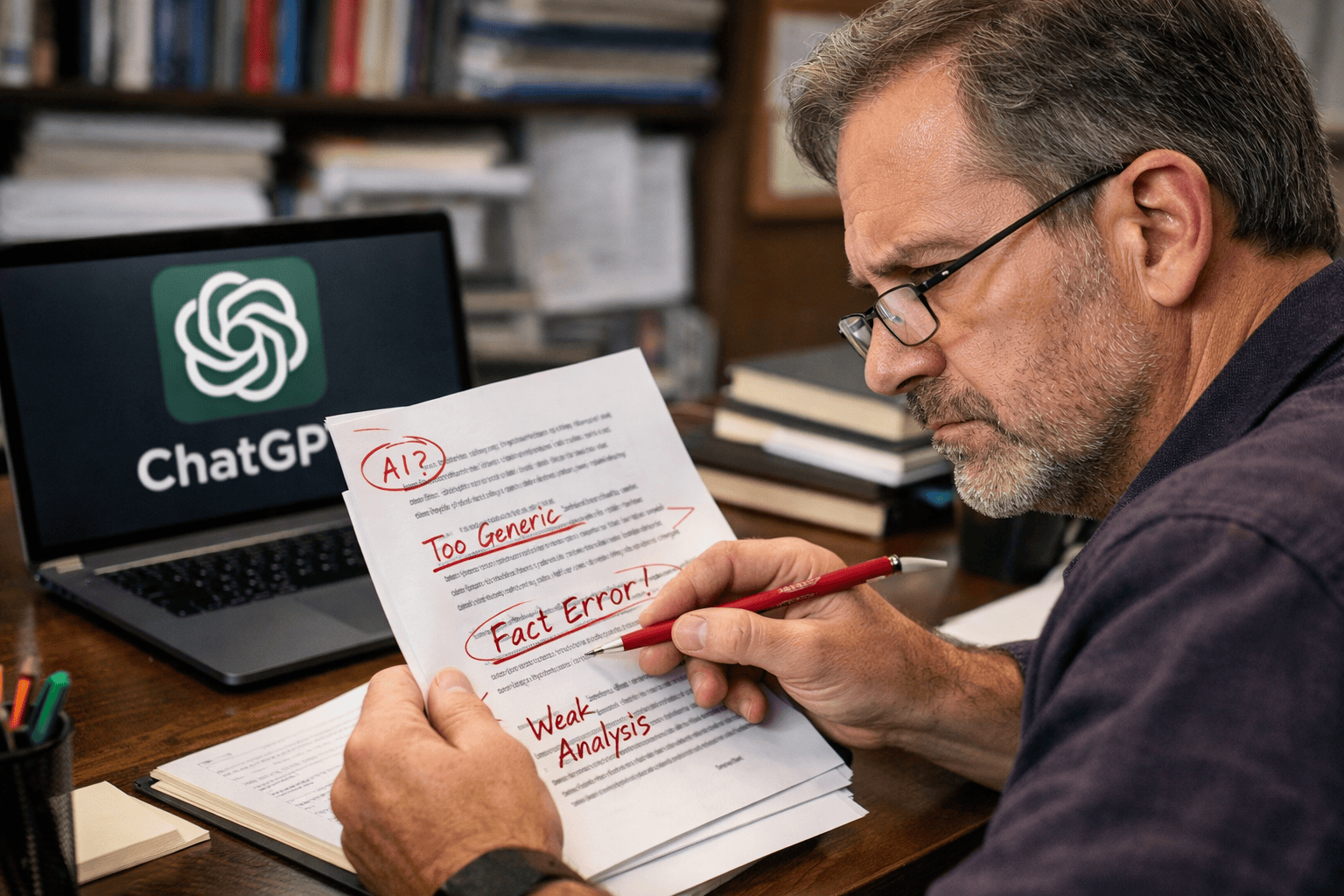
Contrary to popular belief, professors do not rely solely on AI detection software like Turnitin. In fact, many educators now combine AI detectors with human judgment, writing pattern analysis, classroom performance, and assignment history to determine whether a paper was likely written using AI.
At the same time, false positives have become a growing issue. Many students are now being incorrectly flagged for AI-generated writing even when they wrote the essay themselves. This has created anxiety and confusion throughout universities in the United States and Canada.
Students trying to improve AI-generated content often search for ways to make their writing sound more natural. You may also find this helpful: How to Make AI-Generated Text More Human-Like.
In this guide, we will explain:
✦ How professors detect AI-written essays in 2026
✦ Which AI detection tools universities use
✦ Why AI detectors often make mistakes
✦ Common signs of AI-generated writing
✦ How false AI flags happen
✦ How students can protect themselves ethically
If you are worried about AI detection in college essays, this article explains what students need to know in 2026.
Why Universities Are Concerned About AI Writing
When generative AI tools became mainstream, universities feared students would begin outsourcing academic work entirely to AI systems.
Professors quickly noticed students using AI to:
✦ Generate complete essays
✦ Rewrite assignments instantly
✦ Create fake citations
✦ Produce discussion board responses
✦ Complete coding assignments
The problem was not simply technology itself. The real concern was academic integrity.
Universities worried AI could undermine:
✦ Independent thinking
✦ Research skills
✦ Critical analysis
✦ Writing ability
✦ Student learning outcomes
As AI tools improved, educational institutions began investing heavily in AI detection systems and new assessment methods.
By 2026, detecting AI-generated writing has become a major focus in higher education.
If you're comparing AI-generated work with expert academic writing, read our detailed comparison guide here: Why 100% Human-Written Papers Are Better Than AI.
How Professors Detect AI-Written Essays
Most students assume professors simply upload papers into an AI detector and immediately know whether ChatGPT was used.
In reality, the process is much more complicated.
Professors now use a combination of technology, behavioral analysis, and academic judgment.
1. AI Detection Software
The most common method universities use is AI detection software.
Popular tools include:
✦ Turnitin AI Detection
✦ GPTZero
✦ Copyleaks AI Detector
✦ Originality.ai
✦ Winston AI
These tools analyze writing patterns and estimate whether content may have been generated by AI.
AI detectors typically evaluate:
✦ Sentence predictability
✦ Repetitive phrasing
✦ Uniform sentence structure
✦ Lack of stylistic variation
✦ Low linguistic complexity
✦ Probability-based text generation patterns
However, AI detectors are far from perfect.
Many universities now acknowledge that AI detection tools can produce inaccurate results and should not be treated as definitive proof of misconduct.
To avoid citation and formatting mistakes while using AI tools, students should also understand referencing properly. Read: MLA 9 vs APA 7 Guide.
2. Writing Style Comparison
One of the most effective ways professors detect AI writing is by comparing a student’s current assignment with previous work.
Professors often notice sudden changes in:
✦ Vocabulary level
✦ Writing tone
✦ Grammar quality
✦ Sentence complexity
✦ Critical thinking depth
✦ Argument structure
For example, if a student who previously struggled with grammar suddenly submits a perfectly polished essay with advanced academic language, instructors may become suspicious.
This is why human judgment remains one of the strongest detection methods.
3. Inconsistent Critical Thinking
AI tools are good at generating fluent text, but they often struggle with genuine critical analysis and original insight.
Professors may identify AI-written essays when papers contain:
✦ Generic arguments
✦ Surface-level analysis
✦ Repetitive explanations
✦ Overly balanced opinions
✦ Lack of personal engagement
✦ Weak evidence evaluation
Many AI-generated essays sound polished but fail to demonstrate deep understanding of course material.
Experienced professors can often recognize this quickly.
Students working on major academic projects may also benefit from these guides:
How to Write a Thesis or Dissertation Step by Step
How to Write a Dissertation Proposal
4. Fake or Inaccurate Citations
One major issue with ChatGPT is hallucinated references.
AI sometimes invents:
✦ Fake academic journals
✦ Nonexistent books
✦ Incorrect article titles
✦ Fabricated DOIs
✦ False publication dates
Professors frequently verify references manually. If citations do not exist, this immediately raises red flags.
Fake references remain one of the easiest ways instructors identify AI-generated assignments.
To improve your research process and verify sources properly, read: How to Use Google Scholar in 2026.
5. Lack of Draft History
Many universities now require students to submit:
✦ Essay outlines
✦ Draft versions
✦ Research notes
✦ Revision history
✦ Google Docs activity
This helps professors evaluate the writing process instead of only the final product.
AI-generated essays often lack evidence of genuine development.
Some instructors also review document version history to see how assignments were created over time.
6. Oral Explanations and Follow-Up Questions
Increasingly, professors ask students to explain their own work verbally.
If a student cannot explain:
✦ Their arguments
✦ Research choices
✦ Sources used
✦ Writing decisions
✦ Key concepts in the paper
It may suggest they relied heavily on AI-generated content.
This method is becoming especially common in graduate programs and writing-intensive courses.
Why AI Detectors Produce False Positives
One of the biggest problems in 2026 is false AI detection.
A false positive happens when AI detection software incorrectly labels human-written work as AI-generated.
This has become a major issue for students.
Common Reasons for False AI Flags
AI detectors often misclassify writing because they rely on statistical probability rather than certainty.
Human-written essays may trigger false flags due to:
✦ Formal academic writing style
✦ Repetitive sentence structures
✦ Grammatically clean writing
✦ Simple vocabulary usage
✦ Non-native English writing patterns
✦ Formulaic essay organization
Ironically, strong academic writing can sometimes appear “too perfect” to AI detectors.
Non-Native English Students Face Higher Risk
Research and student complaints suggest non-native English speakers are more likely to be falsely flagged by AI detection systems.
This happens because:
✦ Simpler sentence structures resemble AI-generated patterns
✦ Predictable grammar can appear machine-written
✦ Limited stylistic variation affects detector scores
As a result, many universities are becoming cautious about relying entirely on AI detection software.
Why Professors Don’t Fully Trust AI Detectors
By 2026, many educators understand that AI detectors are unreliable on their own.
Most universities now treat AI detection reports as indicators rather than proof of misconduct.
Professors increasingly combine:
✦ Human review
✦ Writing comparisons
✦ Classroom performance
✦ Oral questioning
✦ Assignment history
✦ Draft analysis
This means a high AI score alone usually does not automatically result in punishment.
How Students Can Avoid False AI Flags Ethically
Students should focus on transparency and authentic writing rather than trying to “beat” AI detectors.
Here are ethical ways to reduce the risk of false flags.
1. Keep Your Drafts and Notes
Always save:
✦ Research notes
✦ Essay outlines
✦ Early drafts
✦ Revision history
✦ Source annotations
These materials help prove your writing process if your work is questioned.
Google Docs version history can be especially useful.
2. Write in Your Natural Voice
Students sometimes over-edit essays to sound overly formal or robotic.
Instead:
✦ Use natural phrasing
✦ Include personal analysis
✦ Vary sentence structures
✦ Avoid repetitive transitions
✦ Demonstrate genuine engagement
Authentic writing is harder to mistake for AI-generated text.
3. Verify Every Citation Carefully
Never trust AI-generated references without checking them manually.
Before submitting an assignment:
✦ Verify journal names
✦ Check publication dates
✦ Confirm DOI numbers
✦ Ensure sources actually exist
Fake references are one of the fastest ways to trigger suspicion.
4. Understand Everything You Submit
If professors ask questions about your essay, you should be able to explain:
✦ Your thesis
✦ Your arguments
✦ Your evidence
✦ Your conclusions
Submitting work you do not fully understand creates serious academic risks.
5. Follow Your Professor’s AI Policy
Every course may have different rules regarding AI use.
Some professors allow:
✦ Brainstorming
✦ Grammar assistance
✦ Study support
Others prohibit AI entirely.
Always read assignment instructions carefully before using AI tools.
Ethical AI Use vs Academic Misconduct
Universities are increasingly distinguishing between ethical AI assistance and dishonest AI replacement.
Generally acceptable uses include:
✦ Brainstorming ideas
✦ Generating outlines
✦ Improving grammar
✦ Clarifying concepts
✦ Creating study materials
However, most universities prohibit:
✦ Submitting fully AI-written essays
✦ Using AI during restricted exams
✦ Fabricating sources
✦ Misrepresenting AI content as original work
The goal is to use AI as a learning tool rather than a shortcut.
If you need structured academic guidance instead of relying completely on AI, read: Essay Writing Assistance in 2026.
The Future of AI Detection in Universities
AI detection technology will continue evolving, but so will AI writing systems.
This creates an ongoing challenge for universities.
Many institutions are now redesigning assessments to focus more on:
✦ Critical thinking
✦ In-class writing
✦ Oral presentations
✦ Personalized assignments
✦ Research processes
✦ Human creativity
Rather than relying entirely on AI detectors, universities are shifting toward evaluating genuine understanding.
This trend will likely define higher education over the next decade.
Final Verdict: Can Professors Detect AI-Written Essays?
Yes, professors can often detect AI-written essays — but not always through software alone.
In 2026, universities use a combination of:
✦ AI detection tools
✦ Human judgment
✦ Writing comparisons
✦ Citation checks
✦ Draft history
✦ Oral questioning
At the same time, false AI flags remain a serious issue, especially for students with formal or non-native English writing styles.
The safest and smartest approach is simple:
✦ Use AI ethically
✦ Follow course policies
✦ Maintain your authentic writing voice
✦ Save your drafts and notes
✦ Verify every source carefully
✦ Understand every sentence you submit
As AI becomes a permanent part of education, students who learn how to use AI responsibly — rather than abuse it — will be best positioned for academic success.
Need Help With Academic Writing?
Whether you need help with proofreading, formatting, citations, research, or structuring your assignments, expert academic support can help you submit stronger work with confidence.





 Chat Now
